Your cart is currently empty!
Category: opioids
oxycodone
Belonging to the group of semi-natural opioids, oxycodone has been since the start a controversial drug.
intro to opioids
Opioids are a group of psychoactive substances. They are sometimes mistakenly referred to as opiates, which is not quite accurate. That’s because opiates are a specific group of opioids, which are derived directly from the opium poppy plant and are 100% natural.
We can divide opioids into three main groups, those are:
- Natural – morphine, codeine
- Semi-synthetic – hydromorphone, oxycodone
- Synthetic – fentanyl, carfentanil
Opioids are generally used mainly for pain relief in oncology and chronic pain patients. They, however, generally cause euphoria and are very potent, which makes people who take them very prone to addiction.
mechanism of action
When opioids enter a person’s blood- stream, they work their way toward nerve cells and attach themselves to opioid receptors. Receptors are anchoring points on the surfaces of cells that combine with specific entities, such as hormones, antibodies or drugs.
When opioids bind to these receptors, they trigger a series of chemical reactions. One of those reactions is to block pain signals, primarily in the central nervous system.
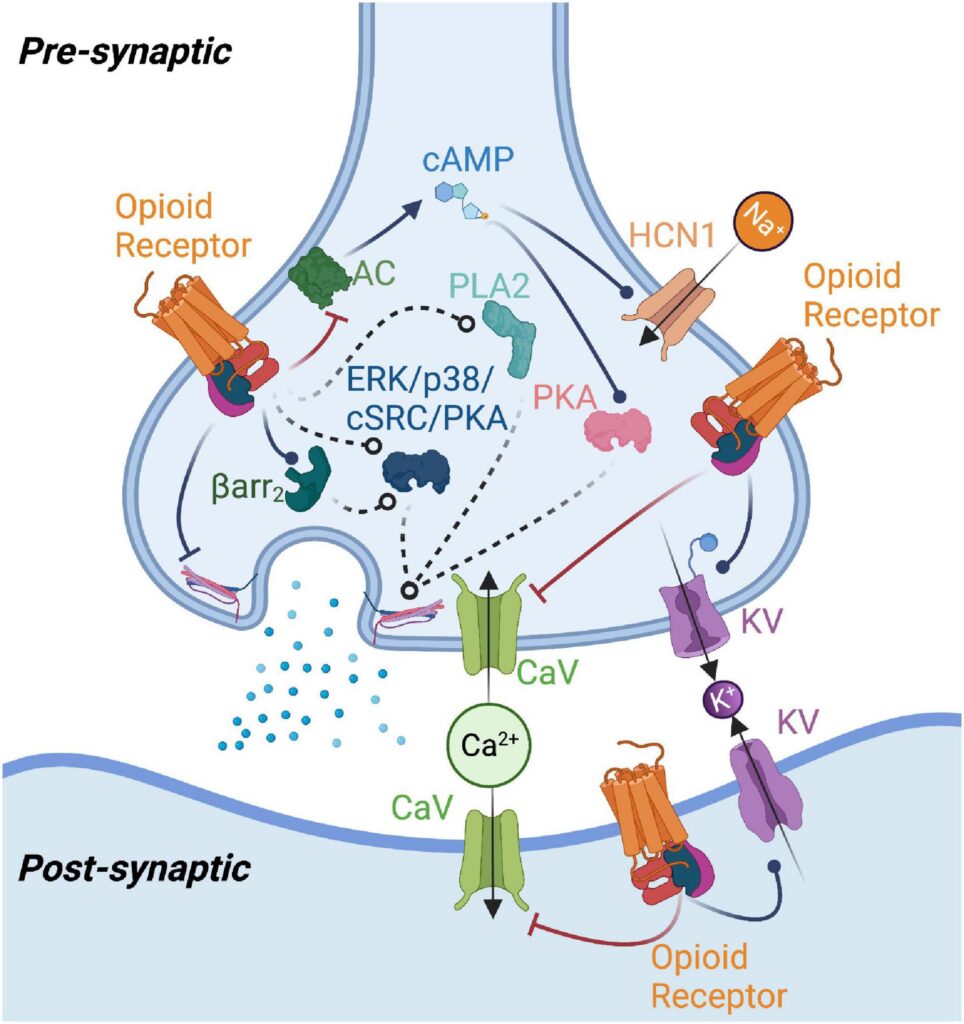
Here’s a picture of a neuron synapse with opioid receptors. To completely understand it, however, you do need to know some neurological anatomy and how synapses work. I’m going to talk about that in some of my future posts.