Your cart is currently empty!
Author: klara.nedbalova@gpjp.cz
oxycodone
Belonging to the group of semi-natural opioids, oxycodone has been since the start a controversial drug.
neurology
To understand the mechanisms of substances, we need to understand some basic neuroanatomy and neurological processes first. Let’s get right into it.
I’m going to leave out a lot of things, because neurology is a very complex and difficult science. I’m going to talk mainly about the synapses and neurotransmitters, which are the most important in understanding mechanisms of drugs that partake in altering the nervous system.
A synapse is the conjunction of two or more neurons.
A synapse is a junction through which a neuron passes information to another neuron. Presynaptic terminals contain chemical neurotransmitters enclosed in small spherical intramembrane structures called synaptic vesicles. When an action potential, a wave of electrical excitation, reaches the presynaptic terminal, the membranes of some synaptic vesicles fuse with the membrane of the presynaptic terminal, thereby opening the vesicles in a process known as exocytosis, which releases their neurotransmitters into the synaptic cleft, the space between the pre and postsynaptic cell membranes. The neurotransmitter diffuses into the cleft and binds to receptors located on the postsynaptic membranes. The fused membranes of synaptic vesicles are retrieved in presynaptic terminals in a procedure called endocytosis, after which they are reused. Maintaining the balance between the amount of exocytosed vesicles and endocytosed vesicles is essential for continuous neurotransmission.
intro to opioids
Opioids are a group of psychoactive substances. They are sometimes mistakenly referred to as opiates, which is not quite accurate. That’s because opiates are a specific group of opioids, which are derived directly from the opium poppy plant and are 100% natural.
We can divide opioids into three main groups, those are:
- Natural – morphine, codeine
- Semi-synthetic – hydromorphone, oxycodone
- Synthetic – fentanyl, carfentanil
Opioids are generally used mainly for pain relief in oncology and chronic pain patients. They, however, generally cause euphoria and are very potent, which makes people who take them very prone to addiction.
mechanism of action
When opioids enter a person’s blood- stream, they work their way toward nerve cells and attach themselves to opioid receptors. Receptors are anchoring points on the surfaces of cells that combine with specific entities, such as hormones, antibodies or drugs.
When opioids bind to these receptors, they trigger a series of chemical reactions. One of those reactions is to block pain signals, primarily in the central nervous system.
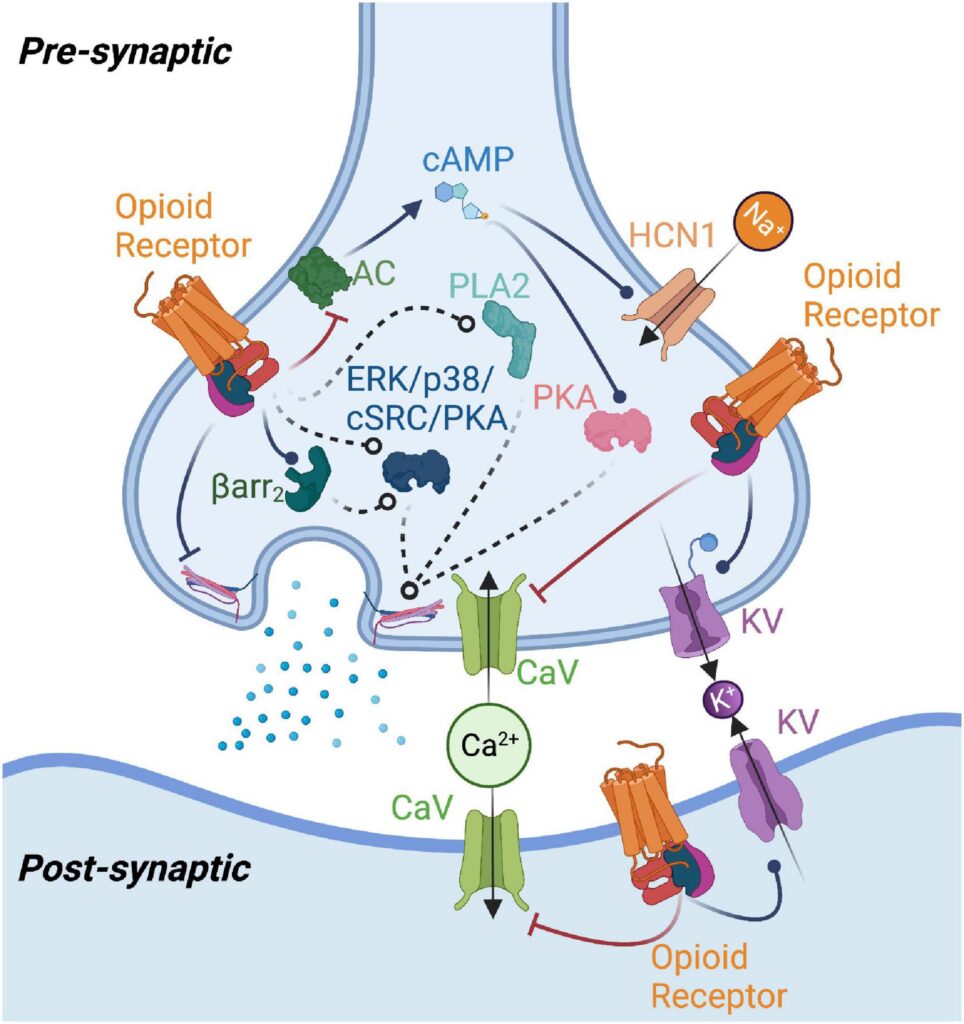
Here’s a picture of a neuron synapse with opioid receptors. To completely understand it, however, you do need to know some neurological anatomy and how synapses work. I’m going to talk about that in some of my future posts.
addiction and dependence
Before we dive into the ocean of specific groups of psychoactive substances and substances themselves, let’s talk about addiction and dependence.
Psychological dependence
There are substances that are more and less likely to cause psychological dependence. One of those can be nicotine, for example. This type of addiction may not be as harmful as the latter, but it can still cause a lot of significant damage to one’s social life, finances and such. It is characterized by the craving of a substance without it causing physical symptoms. However, as we know, everything in the body is connected – psychosomatic symptoms exist.
Physical dependence
This is where it gets a little serious, since the absence of a substance that has been used regularly can cause physical symptoms, which may vary from mild to very severe and life-threatening. Examples of drugs that have a high potential to cause physical dependence are opioids, benzodiazepines, alcohol and so on.